Tag: George Washington

Discover the Hidden Wonders of Northern Central Park: The Best Central Park Walking Tour Experience

Best Central Park Tour


If you’re searching for the best Central Park walking tour, most options focus on the famous southern landmarks—but true magic lies in the north. The “Secret Places of Central Park” walking tour above 100th Street reveals hidden landscapes, rich history, and breathtaking scenery that most visitors never experience. This is where a historian-led Central Park walking tour truly stands apart.

At Central Park’s northern end, far from the crowds, you’ll discover a side of the park that feels like a wilderness escape. Designed by Frederick Law Olmsted and Calvert Vaux, this area reflects their vision to “translate democratic ideas into trees and dirt.” On a guided Central Park tour, you’ll explore the North Woods, a 40-acre forest filled with oak, hickory, maple, and ash trees—an immersive landscape that feels more like the Adirondacks than Manhattan.

One of the highlights of any Central Park sightseeing tour in the north is the Loch, a winding stream with cascading waterfalls that creates a peaceful, almost cinematic setting. Along the way, you’ll pass beneath Huddlestone Arch, an engineering marvel built in 1866 using uncut Manhattan schist without mortar. This stop alone makes the best Central Park tours unforgettable, blending natural beauty with 19th-century craftsmanship.

History is woven into every step of this Central Park guided tour. On higher ground stands the Blockhouse, the park’s oldest original structure, dating back to the War of 1812. This site offers a powerful connection to early American history. You’ll encounter fort areas that the British occupied for seven years of the Revolutionary War, and a path that George Washington used on several occasions. A Central Park history tour brings these stories vividly to life, transforming a simple walk into an engaging journey through time.

The visit to the Conservatory Garden provides a surprising landscape along the tour. You’ll step into three formal European-style gardens hidden within the park. This stop is often a favorite on a Central Park private tour or small-group experience, offering a peaceful escape from the city. Nearby, the Harlem Meer opens into sweeping views that make you forget you’re in New York City. It’s moments like these that define the top-rated Central Park tours—unexpected, serene, and deeply memorable.

Beyond the scenery, the most meaningful Central Park tours NYC also explore what came before the park. This land was once home to Seneca Village, a thriving African American and immigrant community. A historian-led Central Park walking tour provides insight into this important and often overlooked history, adding depth and perspective to the experience.

For travelers searching for the best walking tours in New York City, the Secret Places of Central Park walking tour offers something truly unique: fewer crowds, richer stories, and landscapes that feel untouched. Whether you’re interested in nature, history, or simply discovering hidden gems, a Central Park walking tour in the north delivers an unforgettable experience—one that reveals the park as it was meant to be seen.
👉 Sign up today for the Secret Places of Central Park and experience some of the most beautiful and historical part of the park.

Where Hamilton the Broadway Musical’s Songs Meet the Streets of Lower Manhattan

Hamilton Walking Tour

Lin-Manuel Miranda’s Hamilton does more than tell the story of Alexander Hamilton—it drops the listener into the geography of early America. Many songs make explicit or implied references to real New York City locations, especially in Lower Manhattan, where much of Hamilton’s adult life unfolded. Some references are direct lyrics; others are dramatic shorthand that mirrors the episodes of history Miranda adapted from primary sources and his own annotations (many shared via Genius.com and other websites).


“The Schuyler Sisters” — History is happening in Manhattan

Right from Act I, when Angelica, Eliza, and Peggy sing about “History is happening in Manhattan,” we’re placed in the political ferment of Lower Manhattan in the 1770s. That area was the island’s heart of commerce, taverns, and debate—where street corners, meeting halls, and social clubs buzzed with talk of revolution. Miranda’s line echoes the city’s reality as the bustling pre-war hub, even if Manhattan then was smaller, more localized, and, after September 1776, under British occupation.


“Aaron Burr, Sir” / “My Shot” — Taverns Like Fraunces Tavern

When Hamilton meets John Laurens, Hercules Mulligan, and Marquis de Lafayette in “Aaron Burr, Sir” and then they proclaim “My Shot,” the scenes evoke the taverns and gathering places of Lower Manhattan—especially Fraunces Tavern. This tavern was a real Revolutionary hub where officers and patriots socialized and discussed strategy. It’s also the site of George Washington’s farewell to his officers in 1783. While the musical doesn’t name the tavern, Genius annotations highlight this historic setting as the plausible place for those youthful toasts to liberty.


“Right Hand Man” — The Battery and Southern Defenses

Alexander Hamilton’s rallying cry that “they’re battering down the Battery” references The Battery, the defensive fortifications at Manhattan’s southern tip designed to protect the harbor. In 1776, Manhattan was the central field of war operations in New York, so the lyric conjures the real geography of military urgency—even if the song condenses battles at Brooklyn Heights, Kip’s Bay, and Harlem into a rapid montage.


“The Room Where It Happens” — 57 Maiden Lane and the Compromise of 1790

In Act II’s “The Room Where It Happens,” Burr envies Hamilton’s political influence. This song refers to the Compromise of 1790, where Hamilton’s assumption of state debts won support in exchange for placing the national capital on the Potomac. That negotiation took place in Thomas Jefferson’s home on Maiden Lane—located in Lower Manhattan. Today the original building is long gone, but a plaque marks the historical site. Miranda turns this diplomatic dinner into an anthem about access to power, turning a specific place into a symbolic “room” for audiences.


“Non-Stop” — Returning to New York as a Law Practitioner

In “Non-Stop,” Hamilton recounts returning to New York after the Revolutionary War to practice law and help build the nation’s institutions. While the lyric doesn’t namecheck places, Genius song annotations connect Hamilton’s work to sites like Federal Hall (then the capital’s meeting place)—the physical center of the new government in Lower Manhattan.


“Schuyler Defeated” — Wall Street Thinks You’re Great

Burr’s barb that “Wall Street thinks you’re great” points to Lower Manhattan’s future financial identity. Warded through theatrical shorthand, Wall Street becomes a symbol for commercial elites who supported Hamilton’s financial system. While the world of 1790 wasn’t a financial district in the modern sense, the area around Wall Street / Federal Hall was indeed the political and financial nerve center.


“Who Lives, Who Dies, Who Tells Your Story” — Trinity Churchyard

An emotional anchor of the show, Eliza sings “She is buried in Trinity Church near you.” This compelling lyric points to Trinity Churchyard in Lower Manhattan, where Hamilton and Eliza are interred, and Angelica’s resting place is nearby. The lyric turns very real cemetery geography into emotional geography, a hallmark of Miranda’s dramatic storytelling.


Where Broadway Songs Become Streets and Stone

Miranda’s writing bridges recorded history and theatrical storytelling. Sometimes the show names a place; other times it captures a moment so vividly that listeners intuitively place it in Lower Manhattan. Genius’s annotations—many contributed by Miranda himself and historians—demonstrate how lyrics draw from primary sources, 18th-century letters, and biographies, and then get shaped for rhythm, rhyme, and emotional impact.


Visit These Spots With the Hamilton & Washington Tour

If you’ve ever been curious about where the characters actually walked, you can experience it on the Hamilton & Washington Walking Tour with Revolutionary Tours NYC. We’ll take you to to see Fraunces Tavern, Federal Hall, Wall Street, and Trinity Churchyard, among others, sharing the full stories behind the song lyrics, and historical debates. You’ll come away with context that deepens your love for the musical—and the living city where its history unfolded.
👉 Sign up today for the Hamilton & Washington Walking Tour and experience the American Revolution where it happened.

Why Does the Declaration of Independence Say “Unanimous” If New York Didn’t Approve It Until July 9?

Best New York City Revolutionary Walking Tour

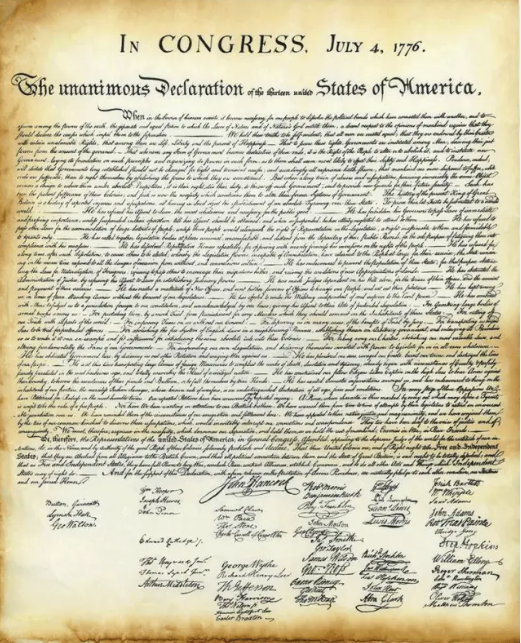
Every July, Americans celebrate the “unanimous” Declaration of Independence adopted on July 4, 1776. But there’s a fascinating wrinkle hiding behind that famous word: on July 4, the vote wasn’t actually unanimous. New York — a critical colony and future major battleground of the Revolution — had not authorized its delegates to support independence. So why does the document proudly proclaim “the unanimous Declaration of the thirteen united States of America”? The answer reveals the messy, human reality behind one of the nation’s most important moments.

To understand this, we need to step back a couple of days before July 4. On July 2, 1776, the Continental Congress voted on Richard Henry Lee’s resolution declaring the colonies independent from Great Britain. Twelve colonies voted in favor. New York abstained — not because its delegates were loyal to the Crown, but because they were bound by instructions from their Provincial Congress, which had not yet authorized a vote for independence. In an era when delegates followed strict legal instructions from their home governments, they simply could not say yes on their own authority.

Two days later, on July 4, Congress approved the final wording of the Declaration of Independence. New York again refrained from voting. Yet importantly, the colony did not oppose the Declaration either. The delegates understood the direction events were moving — they were simply waiting for official approval from home.

That approval arrived on July 9, 1776, when New York’s Provincial Congress met in White Plains and finally endorsed independence. With that decision, New York’s delegates were free to join their colleagues. In the weeks that followed, as the Declaration was printed, circulated, and eventually engrossed for signing in August, all thirteen states had formally aligned themselves with the revolutionary cause. By the time most delegates signed the famous parchment on August 2, the colonies truly were united — making the description “unanimous” politically accurate, even if it wasn’t technically true on July 4 itself.

New York’s hesitation reflects the colony’s unique position in 1776. Economically tied to Britain, politically divided, and strategically vulnerable, New York faced enormous risks. British forces were already preparing to target the city, and many residents were cautious about a complete break with the empire. Understanding this context adds depth to the story of independence and reminds us that unity was achieved through a process — not a single dramatic moment.

This nuance is just one example of how Revolutionary-era history is often more complex and compelling than what we learned in school. On Revolutionary Tours NYC’s Hamilton & Washington walking tour, visitors explore the real-life settings where New York wrestled with loyalty, resistance, and ultimately revolution. From Federal Hall to Fraunces Tavern and beyond, the tour reveals how figures like Alexander Hamilton and George Washington navigated the uncertain days when independence was far from guaranteed.

So the next time you read the Declaration’s opening line, remember that “unanimous” reflects the final unity the colonies achieved — not the perfectly synchronized vote we often imagine. The road to independence was uneven, cautious, and deeply human — and New York’s late but decisive support is a powerful reminder that the Revolution was built step by step, colony by colony, until a shared vision finally emerged.
👉 Sign up today for the Hamilton & Washington Walking Tour and experience the American Revolution where it happened.

The Perfect New York City Tour for America’s 250th: Washington, Hamilton, and the Revolutionary City

250th Revolutionary Tour New York City

This year, the United States marks its 250th anniversary—the Semiquincentennial—an opportunity to reflect on how a fragile rebellion became a nation. There is no better place to experience that story than New York City, and no better way to encounter it than on the Hamilton & Washington: Secrets of the Past Walking Tour.

New York was not merely a backdrop to the American Revolution—it was one of its central stages. Long before the Declaration of Independence was read aloud in July 1776, New Yorkers were already locked in struggle over liberty, power, and the future of empire. During the Revolution, the city witnessed dramatic protest, crushing defeat, daring escapes, espionage, and—ultimately—the birth of the United States itself. Our Washington & Hamilton tour places you directly on those streets, where history unfolded step by step.

This immersive walking tour explores the Revolution and the early republic through the intertwined lives of George Washington and Alexander Hamilton—two indispensable figures who shaped America’s destiny. Washington, the steadfast Commander-in-Chief and first President, guided the nation through war and into republican government. Hamilton, an orphaned immigrant with towering ambition, helped design the financial and constitutional foundations that allowed the United States to survive. Their partnership—and their tensions—define the Revolutionary era.

As the nation commemorates its 250th anniversary, this tour offers something deeper than monuments and dates. You will encounter the Revolution as lived experience: the Sons of Liberty resisting British taxation, the devastating consequences of the Battle of Brooklyn, Washington’s providential nighttime escape across the East River, and his emotional farewell to the Continental Army at a Manhattan tavern. You’ll stand near the site of Washington’s triumphant inauguration on Wall Street and explore how Hamilton’s economic vision reshaped the future of the nation.

Importantly, the Semiquincentennial demands a fuller story—and this tour delivers it. Alongside Washington and Hamilton, you’ll meet African Americans who fought for freedom, women who sustained the Patriot cause, and lesser-known figures whose contributions were vital to independence. You’ll learn how intelligence networks like the Culper Spy Ring helped save the Revolution, and how ideas expressed in the Federalist Papers secured ratification of the Constitution.

For visitors inspired by Hamilton on Broadway, this tour provides historical depth behind the drama—grounded in scholarship, primary sources, and place-based storytelling. For lifelong history enthusiasts, it offers rare insight into New York’s Revolutionary past. And for the 250th anniversary, it provides something essential: context, complexity, and connection.

As America reflects on its founding at 250 years, join us to walk the city where independence was contested, nearly lost, and ultimately secured. The Semiquincentennial deserves more than a celebration—it deserves understanding.
👉 Sign up today for the Hamilton & Washington Walking Tour and experience the American Revolution where it happened.

Unity in Leadership: Washington’s 1783 Letter to Hamilton

Best Hamilton Tour in NYC

In March 1783, as the Revolutionary War drew to a close, George Washington drafted a letter from Newburgh, New York to his trusted associate Alexander Hamilton that revealed the depth of his vision for the newly independent United States. This letter reflects not only Washington’s happiness at the close of the war but also his concerns and vision for the future of the United States.

Unity

Washington’s letter reveals his optimism about the potential of the new nation to become “a great, respectable, and happy People” but also his awareness that realizing this vision would require more than just the end of the long conflict with England. Internal divisions, petty politics, and “unreasonable jealousies & prejudices,” he understood, could undermine the nation’s progress, making it vulnerable to foreign powers seeking to dissolve the government running under the Articles of Confederation through intervention.

Washington’s words serve as a powerful reminder of the importance of unity and cooperation in achieving greatness. He understood that the path to success was about building a strong, cohesive society where all citizens could thrive.

Reform

One of the most striking aspects of Washington’s letter is his prescience in his candid assessment of the defects in the existing Confederation and the need for reform and and a nation built upon “liberal & permanent principles.” He understood that many of the war’s challenges, including its prolongation and expense, were due to the lack of power vested in Congress. This insight highlights Washington’s foresight in recognizing the need for a more robust central government, a vision that he and Alexander Hamilton shared that would later shape the creation of the U.S. Constitution.

Washington’s call for reform was not simply intellectual; it was deeply personal. He had experienced firsthand the difficulties caused by a weak Congress during the war. The letter reveals his frustration with the “prejudices of some” and the “designs of others,” which made it challenging to implement needed reforms

Collaboration

What makes Washington’s letter truly remarkable is his willingness to collaborate and seek advice. He eagerly awaited Hamilton’s thoughts on these matters, demonstrating the value he placed on other perspectives. This approach to governance is still essential today, as leaders must navigate complex challenges and, for the betterment of the nation, engage with different viewpoints.

Lessons

Washington’s letter offers wisdom that resonates deeply in today’s divisive political landscape. His emphasis on unity, principled governance, and visionary leadership is a powerful reminder of how to build a strong and prosperous nation.

In an era marked by polarization, Washington’s words remind us of the importance of putting aside our differences and working towards common national goals. His call for a robust and effective government structure is a reminder that systemic issues must be addressed to ensure the well-being of all citizens.

Conclusion

George Washington’s letter to Alexander Hamilton is a blueprint for building a better future. It reminds us that the strength of a nation lies in its ability to unite, reform, and lead with vision and integrity. As we navigate the complexities of today, Washington’s letter stands as a testament to the enduring power of unity, collaboration, and principled leadership.

You can experience more about Washington & Hamilton’s visionary partnership on the Washington & Hamilton in New York Walking tour. Book it Today!

Here is the complete letter:

From George Washington to Alexander Hamilton, 31 March 1783

Newburgh 31st March 1783

Dear Sir,

I have duly received your favors of the 17th & 24 Ulto—I rejoice most exceedingly that there is an end to our Warfare, and that such a field is opening to our view as will, with wisdom to direct the cultivation of it, make us a great, a respectable, and happy People; but it must be improved by other means than state politics, and unreasonable jealousies & prejudices; or (it requires not the second sight to see that) we shall be instruments in the hands of our Enemies, & those European powers who May be jealous of our greatness, in Union to dissolve the confederation—but to attain this, altho’ the way seems extremely plain, is not so easy.

My wish to see the Union of these States established upon liberal & permanent principles—& inclination to contribute my mite in pointing out the defects of the present Constitution, are equally great—All my private letters have teemed with these Sentiments, & whenever this topic has been the Subject of conversation, I have endeavoured to diffuse &enforce them; but how far any further essay, by me, might be productive of the wished for end–or– appear to arrogate more than belongs to me, depends so much upon popular opinions & the temper and disposition of People, that it is not easy to decide. I shall be obliged to you however for the thoughts which you have promised me on this Subject, and as soon as you can make it convenient.

No Man in the United States is, or can be more deeply impressed with the necessity of a reform in our present Confederation than myself—No Man perhaps has felt the bad efects of it more sensibly; for to the defects thereof, & want of Powers in Congress may justly be ascribed the prolongation of the War, & consequently the Expences occasioned by it. More than half the perplexities I have experienced in the course of My command, and almost the whole of the difficulties & distress of, the Army, have there origin here; but still, the prejudices of some—the designs of others—and the mere Machinery of the Majority, makes address & management necessary to give weight to opinions which are to Combat the doctrines of these diferent classes of Men, in the field of Politics.

I would have been more full on this subject but the bearer (in the Clothing department) is waiting—I wish you may understand what I have written. I am Dr Sir Yr Most Obed Servt

Go: Washington

P.S. The inclosed extract of a Letter to Mr Livingston, I give you in confidence—I submit it to your consideration, fully perswaded that you do not want inclination to gratify the Marquis’s wishes as far as is consistent with our National honor. (1)

1 George Washington to Alexander Hamilton, 31 March 1783, Founders Online, National Archives, accessed March 27, 2025, https://founders.archives.gov/documents/Washington/99-01-02-10968.

Find the Washington & Hamilton in New York tour and other New York Historical Tours at Revolutionary Tours NYC

America’s 250th Anniversary, the Semiquincentennial in New York City

Celebrate America's 250th - Semiquincentennial in New York City

As we approach the United States’ Semiquincentennial in 2026, marking 250 years since the birth of our nation, it’s fitting to reflect on New York City’s pivotal role in the American Revolution and the Early Republic. Today’s bustling metropolis was once a crucible and battleground where the fate of the nascent nation hung in the balance and after the war, the first capital city.

In the summer of 1776, New York became the center stage for one of the Revolution’s most crucial campaigns. General George Washington, recognizing the city’s strategic importance, fortified it against British attack. Despite his efforts, the New York Campaign proved to be one of the lowest points of his military career. The little-known Battle of Brooklyn in August 1776 saw the Continental Army suffer a crushing defeat. Yet, in a daring nighttime maneuver Washington saved the army and the revolutionary cause.

While the British held New York for the longest occupation of the war, the city’s revolutionary spirit persisted. It was here that Alexander Hamilton, a young immigrant artillery officer, caught the attention of the military and began his ascent to Founding Father. It was here that Washington bade farewell to his officers and generals, and it was here that he took the oath as the nation’s first president.

As we look forward to the Semiquincentennial celebrations, New York’s revolutionary history reminds us of the courage and perseverance that birthed our nation by men and women and Black and white. On the Washington & Hamilton in New York tour, you’ll discover the historic streets of Lower Manhattan that still echoes with the footsteps of those who fought for independence and created a new nation. The immersive tour will entertain and educate through historic sites, storytelling, and images as we reflect on the past and gain greater insights into the present. Book the tour today!

George Washington’s Inauguration in New York City

Washington & Hamilton tour

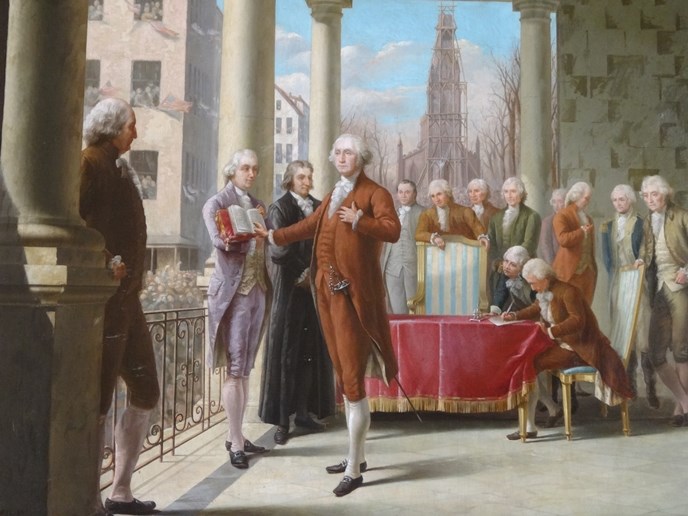
On April 30, 1789, on the balcony of Federal Hall in New York City, a very nervous George Washington, walking “on untrodden ground,” took the oath as the first president of the United States. (1) “No event could have filled me with greater anxieties,” he stated. The oath was administered by Robert Livingston, the Chancellor of New York State, and was witnessed by hundreds of citizens lining Wall and Broad Streets. After taking an oath to defend the Constitution, he entered the Senate Chamber and delivered his Inaugural Speech to the assembled members of Congress. James Madison helped him compose a short speech that contained the poignant words, “The preservation of the sacred fire of liberty and the destiny of the republican model of government are justly considered, perhaps, as deeply, as finally, staked on the experiment entrusted to the hands of the American people.” (2) The United States finally achieved a republican government comprised of “we the people.” To this day, the nation still strives to carry on the pursuit of a more perfect union. See the site of Washington’s historic inauguration on the Washington & Hamilton in New York tour.

Here is Washington’s entire Inaugural Speech:

Fellow-Citizens of the Senate and of the House of Representatives:

Among the vicissitudes incident to life no event could have filled me with greater anxieties than that of which the notification was transmitted by your order, and received on the 14th day of the present month. On the one hand, I was summoned by my Country, whose voice I can never hear but with veneration and love, from a retreat which I had chosen with the fondest predilection, and, in my flattering hopes, with an immutable decision, as the asylum of my declining years–a retreat which was rendered every day more necessary as well as more dear to me by the addition of habit to inclination, and of frequent interruptions in my health to the gradual waste committed on it by time. On the other hand, the magnitude and difficulty of the trust to which the voice of my country called me, being sufficient to awaken in the wisest and most experienced of her citizens a distrustful scrutiny into his qualifications, could not but overwhelm with despondence one who (inheriting inferior endowments from nature and unpracticed in the duties of civil administration) ought to be peculiarly conscious of his own deficiencies. In this conflict of emotions all I dare aver is that it has been my faithful study to collect my duty from a just appreciation of every circumstance by which it might be affected. All I dare hope is that if, in executing this task, I have been too much swayed by a grateful remembrance of former instances, or by an affectionate sensibility to this transcendent proof of the confidence of my fellow-citizens, and have thence too little consulted my incapacity as well as disinclination for the weighty and untried cares before me, my error will be palliated by the motives which mislead me, and its consequences be judged by my country with some share of the partiality in which they originated.

Such being the impressions under which I have, in obedience to the public summons, repaired to the present station, it would be peculiarly improper to omit in this first official act my fervent supplications to that Almighty Being who rules over the universe, who presides in the councils of nations, and whose providential aids can supply every human defect, that His benediction may consecrate to the liberties and happiness of the people of the United States a Government instituted by themselves for these essential purposes, and may enable every instrument employed in its administration to execute with success the functions allotted to his charge. In tendering this homage to the Great Author of every public and private good, I assure myself that it expresses your sentiments not less than my own, nor those of my fellow- citizens at large less than either. No people can be bound to acknowledge and adore the Invisible Hand which conducts the affairs of men more than those of the United States. Every step by which they have advanced to the character of an independent nation seems to have been distinguished by some token of providential agency; and in the important revolution just accomplished in the system of their united government the tranquil deliberations and voluntary consent of so many distinct communities from which the event has resulted can not be compared with the means by which most governments have been established without some return of pious gratitude, along with an humble anticipation of the future blessings which the past seem to presage. These reflections, arising out of the present crisis, have forced themselves too strongly on my mind to be suppressed. You will join with me, I trust, in thinking that there are none under the influence of which the proceedings of a new and free government can more auspiciously commence.

By the article establishing the executive department it is made the duty of the President “to recommend to your consideration such measures as he shall judge necessary and expedient.” The circumstances under which I now meet you will acquit me from entering into that subject further than to refer to the great constitutional charter under which you are assembled, and which, in defining your powers, designates the objects to which your attention is to be given. It will be more consistent with those circumstances, and far more congenial with the feelings which actuate me, to substitute, in place of a recommendation of particular measures, the tribute that is due to the talents, the rectitude, and the patriotism which adorn the characters selected to devise and adopt them. In these honorable qualifications I behold the surest pledges that as on one side no local prejudices or attachments, no separate views nor party animosities, will misdirect the comprehensive and equal eye which ought to watch over this great assemblage of communities and interests, so, on another, that the foundation of our national policy will be laid in the pure and immutable principles of private morality, and the preeminence of free government be exemplified by all the attributes which can win the affections of its citizens and command the respect of the world. I dwell on this prospect with every satisfaction which an ardent love for my country can inspire, since there is no truth more thoroughly established than that there exists in the economy and course of nature an indissoluble union between virtue and happiness; between duty and advantage; between the genuine maxims of an honest and magnanimous policy and the solid rewards of public prosperity and felicity; since we ought to be no less persuaded that the propitious smiles of Heaven can never be expected on a nation that disregards the eternal rules of order and right which Heaven itself has ordained; and since the preservation of the sacred fire of liberty and the destiny of the republican model of government are justly considered, perhaps, as deeply, as finally, staked on the experiment entrusted to the hands of the American people.

Besides the ordinary objects submitted to your care, it will remain with your judgment to decide how far an exercise of the occasional power delegated by the fifth article of the Constitution is rendered expedient at the present juncture by the nature of objections which have been urged against the system, or by the degree of inquietude which has given birth to them. Instead of undertaking particular recommendations on this subject, in which I could be guided by no lights derived from official opportunities, I shall again give way to my entire confidence in your discernment and pursuit of the public good; for I assure myself that whilst you carefully avoid every alteration which might endanger the benefits of an united and effective government, or which ought to await the future lessons of experience, a reverence for the characteristic rights of freemen and a regard for the public harmony will sufficiently influence your deliberations on the question how far the former can be impregnably fortified or the latter be safely and advantageously promoted.

To the preceding observations I have one to add, which will be most properly addressed to the House of Representatives. It concerns myself, and will therefore be as brief as possible. When I was first honored with a call into the service of my country, then on the eve of an arduous struggle for its liberties, the light in which I contemplated my duty required that I should renounce every pecuniary compensation. From this resolution I have in no instance departed; and being still under the impressions which produced it, I must decline as inapplicable to myself any share in the personal emoluments which may be indispensably included in a permanent provision for the executive department, and must accordingly pray that the pecuniary estimates for the station in which I am placed may during my continuance in it be limited to such actual expenditures as the public good may be thought to require.

Having thus imparted to you my sentiments as they have been awakened by the occasion which brings us together, I shall take my present leave; but not without resorting once more to the benign Parent of the Human Race in humble supplication that, since He has been pleased to favor the American people with opportunities for deliberating in perfect tranquility, and dispositions for deciding with unparalleled unanimity on a form of government for the security of their union and the advancement of their happiness, so His divine blessing may be equally conspicuous in the enlarged views, the temperate consultations, and the wise measures on which the success of this Government must depend. (3)

1 George Washington, “From George Washington to Catharine Sawbridge Macaulay Graham, 9 January 1790, National Archives Founders Online, last accessed January 20, 2025, https://founders.archives.gov/documents/Washington/05-04-02-0363.

2 George Washington, “President George Washington’s First Inaugural Speech (1789),” National Archives Milestone Documents, last accessed January 20, 2025, https://www.archives.gov/milestone-documents/president-george-washingtons-first-inaugural-speech.

3 Ibid.

George Washington’s Real Right Hand Man

George Washington and William Lee

While some may consider Alexander Hamilton George Washington’s “Right Hand Man,” the more compelling choice is William Lee, the African American enslaved valet who served Washington for approximately twenty years, including over seven years of the Revolutionary War. (1) From helping the command-in-chief arrange his personal business, to delivering dispatches, to assisting with sartorial tasks, to accompanying Washington on fox hunts, Lee was the ever-present assistant. (1)

In the 1780s, Lee suffered a number of falls that affected his knees. Washington noted in his diary, April 22, 1785, “My Servant William (one of the Chain Carriers) fell, and broke the pan of his knee wch. put a stop to my Surveying; & with much difficulty I was able to get him to Abingdon, being obliged to get a sled to carry him on, as he could neither Walk, stand, or ride. . . ” (2) When Washington became president in 1789, Lee travelled from Mount Vernon to serve Washington in New York City. On his way to the new capital, Lee needed took a detour in Philadelphia to be fitted with a steel brace. Tobias Lear, Washinton’s secretary, wrote that if Lee “is still anxious to come on here the President would gratify him altho’ he will be troublesome. He has been an old & faithful servant. This is enough for the Presidt to grafiy him in every reasonable wish. . . ” (3) Washington’s loyalty was evident, but Lee’s loyalty to his enslaver, was even more so. Due to his injuries, in the summer of 1790, Lee returned to Virginia to serve as the Mount Vernon cobbler. (4)

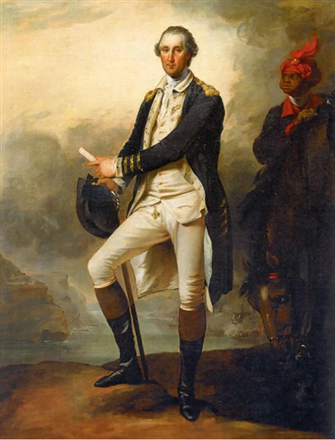
In George Washington’s will, William Lee is the only enslaved person freed on his death. Washington also left him with a $30 annuity. “And to my Mulatto man William,” Washington wrote, “I give immediate freedom; or if he should prefer it (on account of the accidents which ha[v]e befallen him, and which have rendered him incapable of walking or of any active employment) to remain in the situation he now is, it shall be optional in him to do so.” (5) Washington continued, “This I give him as a testimony of my sense of his attachment to me, and for his faithful services during the Revolutionary War.” (6). Lee was it seemed, Washington’s right hand man. See above for John Trumbull’s 1780 painting, “George Washington,” with the general accompanied by William Lee.

  1. “William (Billy) Lee,” George Washington’s Mount Vernon Digital Encyclopedia, https://www.mountvernon.org/library/digitalhistory/digital-encyclopedia/article/william-billy-lee/.
  2. George Washington, “Diary of George Washington (April 22, 1785),” Encyclopedia Virginia: Virginia Humanities, https://encyclopediavirginia.org/entries/diary-of-george-washington-april-22-1785/.
  3. “William Lee,” Encyclopedia Virginia: Virginia Humanities, https://encyclopediavirginia.org/entries/lee-william-fl-1768-1810/.
  4. Ibid.
  5. George Washington, “George Washington’s Last Will and Testament (July 9, 1799),” Encyclopedia Virginia: Virginia Humanities, https://encyclopediavirginia.org/entries/george-washingtons-last-will-and-testament-july-9-1799/.
  6. Ibid.

John Laurens and George Washington

John Laurens and George Washington

South Carolinian John Laurens, close friend to Alexander Hamilton, was fervent in plans to enlist enslaved people in the Continental Army. On March 29, 1779, the Continental Congress agreed to compensate Georgian and South Carolinian slaveholders as much as $1,000 for enslaved men serving in the army, even going as far as emancipation. The Continental Congress stated:

Resolved, That congress will make provision for paying the proprietors of such negroes as shall be inlisted for the service of the United States during the war, a full compensation for the property at a rate not exceeding one thousand dollars for each active able bodied negro man of standard size, not exceeding thirty five years of age, who shall be so inlisted and pass muster.

That no pay or bounty be allowed to the said negroes, but that they be cloathed and subsisted at the expence of the United States.

That every negro who shall well and faithfully serve as a soldier to the end of the present war, and shall then return his arms, be emancipated and receive the sum of fifty dollars.

However, in a letter to George Washington on May 19, 1782, Laurens reported that the plan was rejected by South Carolina. “The single voice of reason,” he wrote, “was drowned by the howlings of a triple-headed monster in which Prejudice Avarice & Pusillanimity were united.”

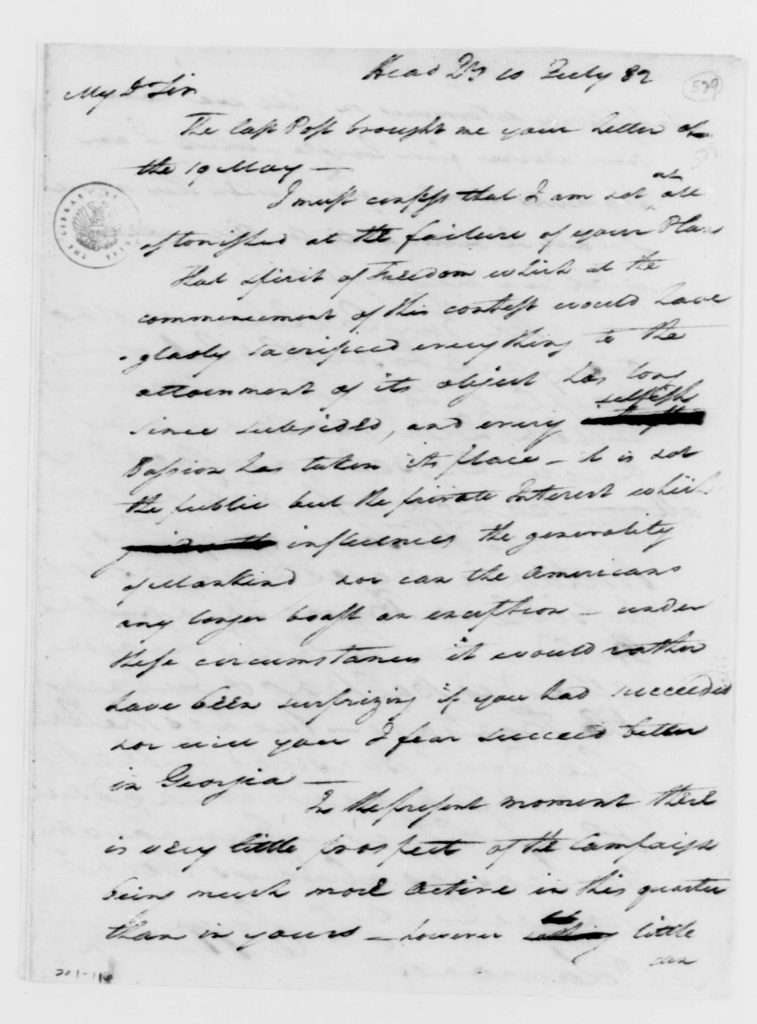
Responding to that letter on July 10, 1782 George Washington (in the letter photographed above) expressed dismay that South Carolina rejected the proposal. He lamented that “it is not the public but the private Interest which influences the generality of mankind.” Washington wrote:

The last Post brought me your Letter of the 19 May.

I must confess that I am not at all astonished at the failure of your Plans.

That Spirit of Freedom which at the commencement of this contest would have gladly sacrificed every thing to the attainment of its object has long since subsided, and every selfish Passion has taken its place—it is not the public but the private Interest which influences the generality of Mankind nor can the Americans any longer boast an exception—under these circumstances it would rather have been surprizing if you had succeeded nor will you I fear succeed better in Georgia.

Other states, such as Rhode Island enlisted African Americans into service. However, many more African Americans escaped and fought on the side of English.

Discover more on the Hamilton & Washington tour. You can purchase tickets on this page. Click the “Book Your Tour” button.

Sources:

“Journals of the Continental Congress, March 29, 1779” Encyclopedia Virginia, https://encyclopediavirginia.org/entries/journals-of-the-continental-congress-march-29-1779.

John Laurens, “To George Washington from John Laurens, 19 May 1782,” National Archives Founders Online, https://founders.archives.gov/documents/Washington/99-01-02-08462.

George Washington, “From George Washington to John Laurens, 10 July 1782,” National Archives Founders Online, https://founders.archives.gov/documents/Washington/99-01-02-08890.

Martha Washington’s Comments on George’s Presidency, 1789

Best Revolutionary War Tour NYC

In a heartfelt letter to Mercy Otis Warren written in New York City on December 26, 1789, Martha Washington expresses her inner feelings about her husband becoming president.

MY DEAR MADAM,

Your very friendly letter of the 27th of last month has afforded me much more satisfaction than all the formal compliments and empty ceremonies of mere etiquette could possibly have done. I am not apt to forget the feelings that have been inspired by my former society with good acquaintances, nor to be insensible to their expressions of gratitude to the President of the United States; for you know me well enough to do me the justice to believe that I am only fond of what comes from the heart.

Under a conviction that the demonstrations of respect and affection which have been made to the President originate from that source, I cannot deny that I have taken some interest and pleasure in them. The difficulties which presented themselves to view on his first entering upon the Presidency seem thus to be in some measure surmounted. It is owing to this kindness of our numerous friends in all quarters, that my new and unwish’d-for situation is not indeed a burden to me. When I was much younger, I should, probably, have enjoyed the innocent gaities of life as much as most of my age; but I had long since placed all the prospects of my future worldly happiness in the still enjoyments of the fireside at Mount Vernon.

I little thought, when the war was finished, that any circumstances could possibly have happened which would call the General into public life again. I had anticipated that from this moment we should have been left to grow old in solitude and tranquility together. That was, my dear madam, the first and dearest wish of my heart; but in that I have been disappointed. I will not, however, contemplate with too much regret disappointments that were inevitable. Though the General’s feelings and my own were perfectly in unison with respect to our predelection for private life, yet I cannot blame him for having acted according to his ideas of duty in obeying the voice of his country. The consciousness of having attempted to do all the good in his power, and the pleasure of finding his fellow-citizens so well satisfied with the disinterestedness of his conduct, will doubtless be some compensation for the great sacrifices which I know he has made. Indeed, in his journeys from Mount Vernon to this place,—in his late tour through the Eastern States,—by every public and every private information which has come to him,—I am persuaded that he has experienced nothing to make him repent his having acted from what he conceived to be alone a sense of indispensable duty. On the contrary, all his sensibility has been awakened in receiving such repeated and unequivocal proofs of sincere regard from all his countrymen.

With respect to myself, I sometimes think the arrangement is not quite as it ought to have been; that I, who had much rather be at home, should occupy a place with which a great many younger and gayer women would be prodigiously pleased.

As my grandchildren and my domestic connections made up a great portion of the felicity which I looked for in this world, I shall hardly be able to find any substitute that would indemnify me for the loss of a part of such endearing society. I do not say this because I feel dissatisfied with my present situation. No. God forbid! for every body and every thing conspire to make me as contented as possible in it. Yet I know too much of the vanity of human affairs to expect felicity from the splendid scenes of public life. I am still determined to be cheerful and to be happy, in whatever situation I may be; for I have also learned from experience that the greater part of our happiness or misery depends upon our dispositions, and not upon our circumstances. We carry the seeds of the one or the other about with us, in our minds, wherever we go.

I have two of my grandchildren with me, who enjoy advantages in point of education, and who, I trust, by the goodness of Providence, will continue to be a great blessing to me. My other two grandchildren are with their mother in Virginia.

The President’s health is quite re-established by his little journey. Mine is much better than it used to be. I am sorry to hear that General Warren has been ill: hope, before this time, that he may be entirely recovered. We should rejoice to see you both. To both I wish the best of Heaven’s blessings, and am,

My dear madam,

With esteem and regard,

Your friend and hble sert,

M. WASHINGTON. (1)

  1. Martha Washington, “Letter from Martha Washington to Mrs. General Warren, New York, December 26, 1789,” American Historical and Literary Curiosities, Part 12, ed. John Jay Smith (New York: Charles B. Richardson, 1860), Project Gutenberg, 2004, last accessed June 7, 2022, https://www.gutenberg.org/files/7912/7912-h/7912-h.htm.